While wandering the net trying to cleanse my brain of the images left by the afore-mentioned author, I found Rob Gonsalves, the Canadian artist responsible for the above painting Medieval Moonlight.
Thanks to years spent at the Minnesota Renaissance Festival, I've developed a love for mystical, Escher-like artists, starting with Randall Spangler (Sanctuary of Knowledge, below....also known as my dream house)
We own several of his large paintings, way more than we have wall space for.
Now I'm hoping to add a Rob Gonsalves to the collection. Maybe this one (Towers of Knowledge -- I think it's a painting of my current livingroom, minus the sunrise):
Must be that time of year - my renaissance roots are showing...
The first is a question: "What do you like the most about your own blog?"
Mostly I like the fact that my daughter can finally read all the family stories she's been asking me to write down, and then finding out that other people enjoy reading it too. From reading their comments, it appears it's not just my family that's crazy.
And the second rule involves sending out this award to 10 other blogs:
First we had the long hot summer. Then we had a series of torrential rainstorms (including the one last Thursday that dumped a tornado on us). The end result was an explosion of plant life (but not the stuff I actually planted-that stuff is deader than roadkill). Above is the path out to my garden. Probably infested with snakes and crickets.
And the side of the house, by the mail box.
And the side of the driveway. There's another foot of pavement hiding under there. If we only had one car, this would be charming. But we have three, two of which need to fit side-by-side, meaning the person parked next to the morning glory bank has to wonder if she's stepping on snakes (that person would be me).
Enter the $15 Halloween prop bought at a yard sale, and sharpened to a fine edge by my daughter. It's a vintage hand scythe, also known as a tobacco knife here in southern Virginia.
It's wicked when swung - cuts through everything, even the thick woody Virginia creeper hiding under the morning glory, and the wall of Paradise trees.
The resulting carnage.
If the rain keeps up, this will be completely covered again in another two weeks.
Last fieldtrip for the summer (at least for me).....
...and we're off at 4:30 am on a huge bus filled with kids and staff on the narrow overgrown mountain roads of southwestern Virginia ....
...to Saltville, Virginia (The Salt Capitol of the Confederacy). Check out those Appalachian Mountains -through the mist you can see the higher peaks behind them. This is more or less my family's old stomping grounds. Down here the accents are thicker and more mountain-ish, rather than those lowland accents, just like my grandparents.
The obligatory cannon - found in most small Southern towns -just like the Confederate statue found in front of most most Southern courthouses (our town just replaced ours on account of some guy lost control and ran into it with his pickup truck. Funny how years of civil rights and societal pressure couldn't do it, but a Chevy S10 could.)
Latest addition to my personal list of favorite tiny libraries: the Saltville Public Library. Love the three sided steps. It sits right next door to....
..our destination: The Museum of the Middle Appalachians.
The high points of the history of Saltville. Above is its claim to fame. Salt. Two hundred feet under the town lies a salt bed almost a mile deep. In prehistoric times animals flocked here for the salt, making animal trails that the various successive Native American tribes later used. Once a deep salty lake, fed by two springs, the deep water gradually fell to form smaller marshy lakes. In the 1700's, the Governor of Virginia, Patrick Henry (of "Give me liberty or give me death fame"), deeded this area to his two sisters. As the salt lakes rose and fell, various fossils and prehistoric bones were picked up, with more than a few being sent to Thomas Jefferson, who among his other accomplishments, was an amateur paleontologist.
Eventually the lakes were drained, and the first of the commercial salt wells were dug. There is no such thing as a salt mine in Saltville. Instead, water is injected through pipes to dissolve the salt. the water is pumped back up, and when it evaporates, it leaves the salt. Most table salt is produced this way. In fact, I can pretty much guarantee no matter who you are, you've consumed some salt from Saltville Virginia within the last week. Semi-loads leave almost on the hour, everyhour, twenty-four hours a day, full of salt destined for every major food producer in the U.S.
At any rate -our kids descended on the Museum, which was entertaining and gracious, and full of Saltville's history...
from mastodons found in the salt wellfield ...
...almost perfectly preserved (cause salt will do that. Remember that the next time you dump that shaker on your food.)....
...to the Cherokee necklaces, bowls and pipes (this may be a clue why my great great grandparents came back here instead of exploring the "Trail of Tears" option)...
...to the original Smyth County Guards Flag from the Civil War (one of my gr-gr's fought in this unit - how cool to get to see the flag- didn't even know it existed)...
...and of course Civil War sabers, currency, pistols, and muskets (repeating rifles???)...it's all here. Even personal accounts of life in a company town. I'm not sure if company towns up north were the same, but in the Appalachians, particularily in mining communities, company towns were a mixed blessing.
Saltville seems to be one of the ones that really prospered under the system. Short version: big company provides 90% of jobs in a community, and the other 10% are peripheral to the success of that company (storeowners for example).
In Saltville's case, Mathieson Alkali not only provided jobs, but hundreds of company houses,in addition to schools, a hospital and healthcare, roads and social events.
They paid their workers in company script - running a tab, and then settling up on payday. The example above shows an employee paycheck for 25 cents in script, the remainder after his tab was tallied. Of course, since the company owned the stores and the bank, it essentially controlled where the paycheck was spent, thus eliminating competition. One must also remember that this was a remote mountain community (and still is in some ways), and the closest store or school, was a minimum of eight miles away, via poor roads, and for a long time, horseback. The closest hospital was much much further. So Saltville became a paradise of sorts.
At least until 1982, when it was declared a Superfund site, because the Mathieson Company had spent years discharging -by it's own estimate- up to 100 pounds a day of methyl mercury into the soil and North fork of the Holston River. (Appalachian corporate history could well serve as the dictionary definition of the word rape. It continues today, rampant and unashamed, just one long gangbang of what was a breathtaking mountainrange. And that's definitely another blog.)
The salt wellfield today. One of the very few places in the world where freshwater plants and saltwater plants grow side-by-side, because the lakes are fed by springs that percolate through the salt beds below the surface.
Saltwater-loving Swamp mallow that grows wild along the shores of the salt wellfield lake (part of the hibiscus family, comes in pink and white).
Of course, it being 90 degrees and blindingly hot, our campers decided to walk the trail around the lakes. Of course.
And this is where the paleontology dig sites are. For all of you dreaming of going into archeology or paleontology, ala Indiana Jones... this is what it really looks like. Deep greyish clay pits, that are constantly being pumped out, because the water table is high enough that the pit refills. The high tech equipment is basically a garden trowel, and every inch of this clay will be moved a trowelful at a time, looking for prehistoric bones. One of the students had the job of balling up handfuls of discarded clay and throwing it up to the opposite side. By the end of the summer, she'll be pitching no-hitters for the Yankees.
Everything they've found that day is in that ziploc bag. Gallon size. Apparently being an archealogist or paleontolist is more than just dodging Nazi's and looking good in a fedora. Who knew?
We were told unofficially that the day before these experts had found *something big* in this dig site, and they had called in outside even-bigger experts to help identify the big something, so we can only assume they were guarding the site and killing time when we walked by.
The result of the finding-of-the-big-something is that our kids (originally meant to be digging in that watery dark grey clay pit) were re-directed to a substitute site.
None of them were fooled. Nevertheless since mud, water, and digging trowels were offered, they did their best to pretend it was a real site.
I mean really...mud is mud....and kids are kids....Peace out.
Once upon a time there was this white boy from Iowa who taught himself to play cornet by ear, using what the music folks call "non-standard fingering", meaning no one else has sounded like him since.
The boy, Bix, fell in love with jazz and eventually blended classical music with New Orleans syncopation (I love that word: syncopation - it describes New Orleans perfectly). After playing with The Wolverines, he joined Frankie Trumbauer and recorded my favorite version of Way Down Yonder in New Orleans.
After playing with a few other jazz greats, Bix began singlehanded creating the image of the jazz musician, the proverbial "Young Man With A Horn": he worked long hours, toured constantly, drank night and day, did multiple stints in various rehab centers (yes, there was even rehab in the Jazz Age), and one hot August night in 1931, he died much too early at the age of twenty-eight.
In the years since Bix Biederbecke has been called the Number One Saint of Jazz, and at one point compared to Jesus (always the kiss of death), with jazz devotees dissecting every aspect of his life from his real name to his sexual orientation, the true cause of his death, and whether or not his contributions were as important as the African-American musicians of the same time period. On most of his original recordings, his name doesn't even appear, being attributed to the orchestras of Frankie Trumbaur, Fletcher Henderson, or Paul Whiteman.
Best quote about Bix, or, rather his playing:
"According to Ralph Berton, he was "as usual gazing off into his private astronomy," but his cornet sounded "like a girl saying yes."
At the time Bix died, he was not a household name. There was one newspaper article in France a couple months later, then nothing until Dorothy Baker published her 1938 novel Young Man With A Horn. That started up the comparisons to Biederbecke, and the various memoirs from musicians who had played with him.
As clarinetist PeeWee Russell said, "He more or less made you play whether you wanted to or not," Russell said. "If you had any talent at all he made you play better."
How did I ever discover Bix?
My grandmother Inez was a jazz baby and long into the early 1960s, she'd put on the old 78's of Bix and ask my grandad to dance with her. There's a mental picture: summer twilight, Bix's cornet music floating in the evening breeze, Arch looking sharp in his fedora, and Inez smiling back at him as they dance to Singin the Blues.
For the umpteenth year in a row, my DD is working at our local science museum. For the second year, she's being paid, and for the first year,she's more or less in charge.This means field trips to various exotic locations. It also means rounding up enough adult staff members, volunteers, and parents to serve as chaperones on those field trips. Bottom line, it means calling her mom to help out in a pinch. A couple weeks ago the journey was to Washington D.C., and this last week the bus rolled south to the North Carolina Zoo.
Above: peace and quiet in an empty bus.
Then campers arrive, and there is no more peace and quiet. Fortunately the bus has a DVD player, and, this being a science camp trip, DVD's of The Tiger, The Bear or The Planet fill up the time on the road. No mindless drivel for these kids.
Welcome to Africa: North Carolina Zoo style. (I've been to Africa, and there are no walkways like this when you arrive, just a dusty airport tarmac, and a guy who wants a tip to give you back your luggage.)
Part of the group, discussing how to see everything in 3 hours, while staying hydrated in 95 degree heat. Also marking every location of all known gift shops.
Love these guys. I saw a baby giraffe born once. But not here, and not today.
Every adult is assigned a child,and this is the great kid assigned to my daughter. By default I ended up spending the day with her as well, and she's now my favorite kid, next to my own daughter. One thing I learned as a parent: my kid's great. Everyone else's drives me crazy. Except this one - she's cool. I'm going to try to be assigned to her on the other field trips too - that'll save me from some of the crazy kids....
The smartest animals at the zoo were once again the elephants. They headed for their pool and made their own sprinkler. I kept wanting to donate a slip n'slide for them.
No idea what these tropical flowers were, but they were blooming next to the rhino field, so I can only imagine what they're fertilized with. The blossoms themselves are about the size of a extra large serving platter.
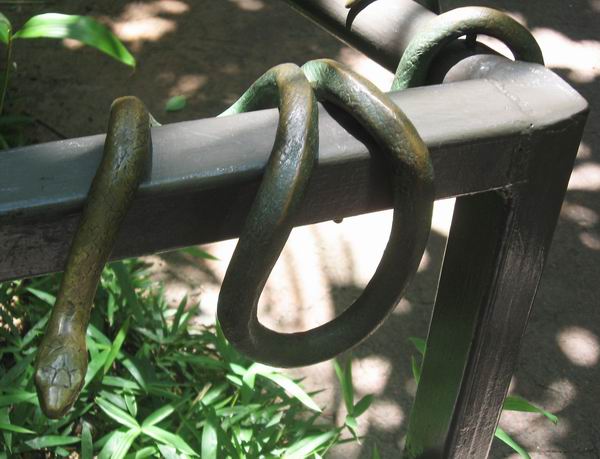
How cool is this? The whole zoo has bronze sculptures of animals tucked in here and there. And this little guy was just draped over a railing. DD wanted to bring him home immediately, but we didn't have a big enough backpack.
Not sure if these were the poisonous frogs or not, but they were in an air-conditioned building, which made them INCREDIBLY popular. I know I glued myself to their tank until someone peeled me off.
Not a lawn ornament, but plays one on the weekend. I grew up watching flamingos at the Audobon Zoo in New Orleans where there were huge flocks. You know why they're pink right? No? You must not have done science camp. Or watched the Animal Planet. Flamingos are pink because they eat crustaceans (shrimp, crawfish, etc). Of course, this begs the question whether all the lovely pink flamingos along the Gulf will now be murky brown, but that's another blog.
Bamboo forest. Waited for crouching tigers, hidden dragons or ninji's here. Nobody showed up.
It's 95 degrees, so we thought we'd go to the desert where it's probably cooler.
This brought back memories of our turtle rescue days, when I made plates of plums, scrambled eats, chopped chicken breast, and lettuce, and served it up to our six box turtles. They loved my cooking. No idea what's wrong with the rest of my family.
Reptiles are messy eaters. But always members of the clean plate club. Sometimes they even eat the plate.
Last photo. Not sure if DD smuggled this guy out or not. He could have fit in the backpack easy.
Guess I should check the snake tanks upstairs.
North Carolina Zoo, opened year round, everyday but Christmas. I really,really strongly suggest going when it isn't 95 degrees.
Usually I keep all the book reviews over at my other blog but this particular book is part of the whole Moonshine Capitol of the World Appalachian folklife culture.
Written by Frank B. Rowlett, Jr., Say...Have I Told You? just summons up all my memories of my granddaddy and the little store at the foot of Wilburn Valley, over in Giles County. It was smaller than my livingroom and had a cast iron potbelly stove sitting on a wooden floor. I used to jump at the chance to ride down there with Granddaddy to get a loaf of white bread or a gallon of store milk.
My favorite part of each trip was seeing all the familiar faces of the other farmers in the valley, and listening to their stories while I drank my Coca-Cola, straight out of the floor cooler.
See, telling stories is a huge part of being Appalachian (it comes from being Scots or Scots-Irish I think). This book is full of those stories, so many of which are being lost, on account of today's children have television and computers to entertain them every waking minute.
"Taletelling or yarn-spinning as it was known in the mountains, is fast becoming a lost art. This is true because most of the country stores and gristmills no longer exist. These two places in the rural setting of yesteryear were the favorite places of the mountaineers as they gathered to swap yarns, to horse trade, perhaps to sip a little moonshine, and to try and solve the world's problems on their own terms.
From the author:
"The mountaineers...are a people whom it is a joy to be around. They are warm and friendly, and when one really gets to know them one finds that they are full of interesting stories and anecdotes and a part of the joy in their acquaintanceship is hearing them tell favorite stories in their own particular way."
Reading this book really brings back my memories of my granddad, Charlie Hodge - his overalls, the sweet smell of his cigarettes, the everpresent plug of tobacco, his weathered hand holding out that ice-cold Coca-Cola, and most of all his stories about running moonshine, working for the CCC, or traveling his mountains by horse and buggy.
I really miss his generation.
Say....Have I Told You?, by Frank B. Rowlett, Jr., 1975, First Edition with dust jacket. Offered for sale by Chewybooks as of July 9,2010.
Mom to an 20-yr-old. After 10 years of homeschool/unschooling adventure she's now working her magic in college. Following a 15 year stint in the corporate sales world, I've spent the last 11 years as an online bookseller with my pup Chewy (Chewybooks on Amazon, Chewyboo on ebay), previous to that I managed a bachelors degree from a radical college, built a small greenhouse 2 years ago and 500 gallon rain barrel system last year.
 While wandering the net trying to cleanse my brain of the images left by the afore-mentioned author, I found Rob Gonsalves, the Canadian artist responsible for the above painting Medieval Moonlight.
 We own several of his large paintings, way more than we have wall space for.
 Must be that time of year - my renaissance roots are showing...




 Posts
Posts


